

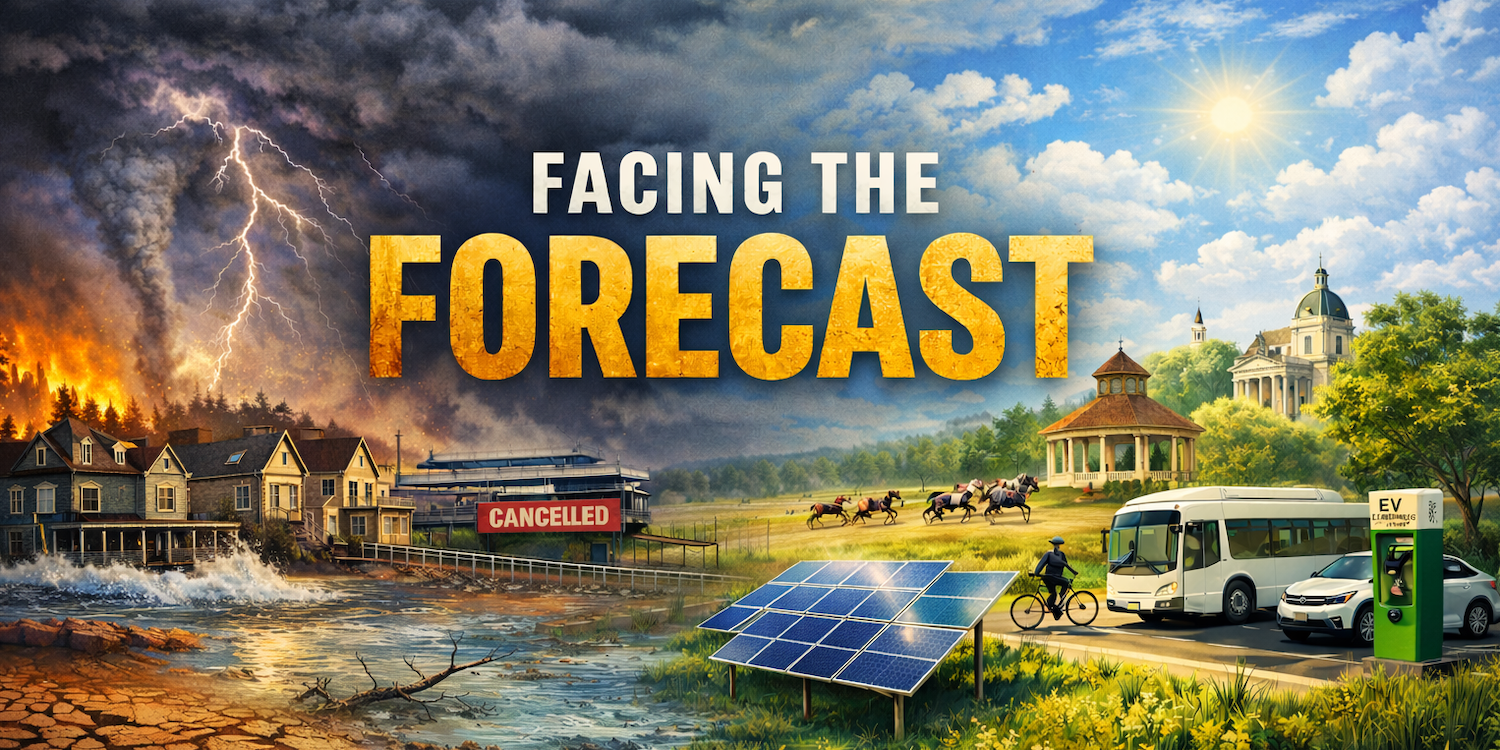
By any scientific standard, the climate in Saratoga Springs has already changed. Summers are hotter. Winters are shorter, wetter, and stranger. Droughts now trade places with downpours. Smoke from fires hundreds of miles away settles over Broadway. Ice storms and flash floods reveal the vulnerabilities of a city built for another century.
These aren't hypothetical risks. They're happening now. And yet, as we move deeper into the age of climate consequences, the most urgent question facing Saratoga Springs is no longer whether to act, but whether our actions match the scale and speed of what’s unfolding around us.
On December 16, the city made a momentous and laudable decision: the formal adoption of its first Municipal Climate Action Plan (MCAP). It is an ambitious document, rooted in data and framed by a bold promise: "Saratoga Springs will be a net zero carbon emissions city by 2050."
But there is a stark tension between this goal and the accelerating science. The MCAP outlines rising temperatures, increased extreme weather, and growing climate vulnerability—particularly for the elderly, low-income residents, and those with health conditions. The number of 95-degree days is expected to rise from 1 per year historically to as many as 43 by the 2080s. Days below zero may all but vanish. Saratoga’s celebrated seasons are shifting.
These forecasts carry local consequences. Horse racing—the city’s economic linchpin—has already canceled race days due to heat. Our winter events depend on reliable snow and safe conditions, now increasingly replaced by slush and ice. Public health is compromised by heatwaves and wildfire smoke. Trees that once thrived are now stressed, their decline hastened by invasive pests flourishing in milder winters.
And emissions? The city's own greenhouse gas inventory reveals a sobering reality: the capped Weibel Avenue landfill, closed in 1991, is still leaking methane and remains the single largest contributor to municipal emissions. A flaring system exists to burn off the gas, but it has worked only intermittently in recent years. Fixing that one system could drastically shrink the city’s carbon footprint—but only if it actually works.
The MCAP provides a credible roadmap to 2050, full of practical strategies—from electrifying the city fleet to decarbonizing buildings to strengthening stormwater infrastructure. What it lacks is assurance of timely implementation. A plan, no matter how sound, is only as strong as the speed and scale of its follow-through.
Consider financing. The MCAP wisely proposes a Green Transition Fund to pay for climate projects. But so far, this fund exists only on paper. The city has identified several sources to seed it: proceeds from the Champlain Hudson Power Express transmission project; a proposed Community Preservation Fund; perhaps even a new municipal bond. Yet none of these mechanisms has been enacted. The money we need to make the plan real remains theoretical.
Meanwhile, the climate clock is not theoretical. Every ton of methane unflared, every building left drafty and gas-heated, every combustion-engine vehicle replaced a year too late, takes us further from our goal.
What Saratoga faces is not a failure of ambition, but a test of commitment. The city has acknowledged the climate emergency. It has created a plan. But plans without investments are promises. And promises without timelines are, ultimately, performances.
There is also the larger political storm. While Saratoga is moving toward clean energy, federal policies swing with every election. The science underpinning our local decisions—much of it from institutions like the National Center for Atmospheric Research—is under attack from political figures who label it alarmist. Our city’s progress depends on facts surviving Washington.
So, what do we owe the future? What does it mean to adopt a climate plan in the era of irreversible change?
The Iroquois principle of the Seventh Generation reminds us to act with the welfare of descendants in mind. That’s more than an ethical slogan. It’s a call to governance.
This is the first and most fundamental question Saratoga Springs must now confront: Are we aligning our goals, timelines, and investments with the reality of a rapidly changing climate?
If we are not prepared to fund the Green Transition Fund now, when will we be? If we cannot keep one landfill flare reliably operational, how will we manage the long arc to net zero? If we shrink from climate truth when it’s politically inconvenient, what hope can we offer our children?
This is the time to turn aspiration into allocation, commitment into calendar, vision into verification. This is the year Saratoga must face the forecast—and respond accordingly.